Tuesday, August 06, 2013

Proposed Transfer of Bale to Real Madrid!

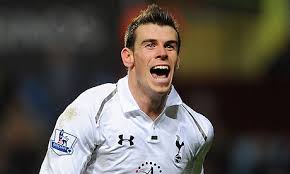
               La Liga giants Real Madrid and English Premier League side Tottenham Hotspurs are said to be close to a potential transfer of Gareth Bale at around £105 million. Real Madrid under manager Carlo Ancelotti, are trying to break through with Bale, though the deal still remains elusive. If this possible transfer is agreed upon by the Spurs, then it could become the world transfer record for the highest ever signing fee ever, beating the £80 million record of Cristiano Ronaldo's move to Real Madrid from Manchester United. 
               Bale, pulled out from Tottenham's 5-2 defeat to Monaco on Saturday. However, he arrived twice consecutively for the Tottenham training sessions. Tottenham manager Andre Villas-Boas insisted that Tottenham would be interested in the offer, only on a player plus cash combination. Real Madrid seem to consider left-back Fabio Coentrao who is valued at £10 million, as the prime candidate for this trade, though Villas-Boas had eyes on striker Alvaro Morata and even former Spur Luka Modric. 
               Spaniard Roberto Soldado, who was newly signed by the Spurs at £26 million, urged Bale to stay at White Hart Lane. Meanwhile, Read Madrid claimed that Bale's transfer was already agreed upon. Bale, a Welshman, was FWA and PFA Player of the Year in 2012-13 and has scored over 40 goals in his Tottenham career. Since then, the 24-year old has been seen as hot property on transfer lists.


Egyptian Revolt 2011-2013

               The Tunisian Revolution of December 2010, was the main cause that provoked the massive revolt in Egypt starting on January 25, 2011. The Tunisian revolution was an anti-government rebellion full of civil resistance and spontaneous protests, the causes being political repression and unemployment. Tunis and other cities in Tunisia burst with protests with demands to dissolve RCD, ruling party since 1956. The then Tunisian President Zine El Abidine Ben Ali resigned, complying to the protests, and the then PM Mohamed Ghannouchi reshuffled the interim government to flush out any RCD members. Soon, he was forced to resign too. Observing this success against oppressive regime, Egypt soon started showing small signs of the outbreak of a big revolution.
               Hosni Mubarak, a National Democratic party member, dubbed as a modern-day Egyptian pharaoh was ruling Egypt since 1981, making him rule Egypt for a whopping 30 years, the most by any Egyptian President. The relentless police abuse, unemployment, electoral fraud, vote rigging and torture were cited as the reasons behind this revolution. Egyptians broke the deadlock, and resorted to self-immolation and started protesting before the Ministry of Internal affairs on January 25, 2011, National Police Day in Egypt. The following two days, civil unrest started in Suez, and pro-Mubarak activists stormed Tahrir Square in Cairo as military was deployed to control the situation.

               At the start of February, Mubarak announced that he would not step down, but remain in the office to oversee a government transition. This escalated protests, as the military tried to restore order. On February 11, 2011, Vice President Omar Suleiman declared Mubarak's resignation, and handed the leadership to the Egyptian Armed Forces. 


               The Egyptian Armed Forces dissolved the Parliament, suspended the Constitution as the protests subsided. The then Prime Minister Ahmed Shafik stepped down. The protests started off freshly again between May and July 2011, as protesters demanded immediate reforms, prosecution of ousted officials including trials of Gamal Mubarak and his father at Tahrir Square as well as Alexandria and Suez. Soon, they started demanding for the dismissal of the Armed Forces' Chairman Mohamed Tantawi as well as the governor of the Aswan province in the Maspero demonstrations. Military opens fire and starts using tear gas to control the thousands of protesters at Tahrir Square, epicentre of the revolution.
               Soon after, Hosni Mubarak and internal affairs minister Habib Al-Adli were convicted to life imprisonment. The Egyptian emergency law was lifted, and martial law was imposed by the military rulers. Two rounds of voting were conducted on May 24 and June 17 2012 which became the first Presidential election after the ouster of Hosni Mubarak.
               Muslim brotherhood candidate Mohamed Morsi, the first Islamist leader of any Arab state, was sworn into office on June 30 2012.
               On November 22, 2012 Morsi granted himself unlimited powers to govern the country, without the review of the judiciary. Egypt erupted yet again as a record 14 million people hit the streets near the Presidential Palace due to Morsi's statement, demanding his resignation from office.


                Morsi, after his decision to expand his authority and suspend judicial interference, Morsi declared a national referendum on Egypt's 2012 Draft Constitution on December 15. Tanks were deployed outside the Presidential Palace and Tahrir Square, but the agitation did not subside. Anti-Morsi protesters, Pro-Morsi protesters as well as the security forces clashed in three-way skirmishes. Anti-Morsi rallies demanded rollback of the Constitutional Declaration. Egypt's stock market plunged by 10%, while the cities of Ismailia, Suez and Port Said became out of control with deadly clashes killing dozens every day.
               Meanwhile, Morsi used sheer brutality to counter the protests with the help of the riot police, who ruthlessly fired gunshots at the protesters. Online outrage, and demonstrations continued, as anti-Morsi people ransacked the Muslim Brotherhood's headquarters.
               On July 1 2013, the Armed Forces issued an 48-hour 'ultimatum' (final statement, which if rejected results in breakdown) to resolve the political crisis. But, Morsi and his supporters, refused to comply. As a result, on July 3 2013, General al-Sisi and Mohamed El-Baradei, leader of National Salvation Front held a meeting. On July 3, it was Mohamed Morsi was removed from power, and Adly Mansour was appointed as acting President.
               In the aftermath of the 'coup d' etat', pro-Morsi protests still prevailed and Islamist insurgents wreaked havoc in the Sinai peninsula. On July 8, 51 protesters will killed dead by security forces in a mass massacre. On July 27, enraged pro-Morsi agitators started protesting in Nasr City, Cairo. This resulted in the deadliest day in the post-Morsi period as over 120 got killed, and around 4500 severely injured. To make a long story short, Egypt is struggling and highly unstable, and what it needs, is a competent, and assertive leader.


Sunday, August 04, 2013

Whitewash in Zimbabwe

               Amit Mishra's 6-wicket haul led India to a comprehensive victory over beleaguered Zimbabwe, at Bulawayo. India secured a 5-0 whitewash of the series without much sweat. Earlier,  Mishra's skilful manoeuvres pummelled Zimbabwe to a paltry total of 163. Then, India knocked off the target in just 34 overs, with Jadeja, Pujara and Rahane scoring around 50 runs each. Amit Mishra became the Man of the Series as he bagged a total of 18 wickets, beating the record of the highest number of wickets by a spinner in a bilateral series. Along with this, India recorded their first clean sweep away from home in a five-match series.
Match Stats:
Zimbabwe 163 (Masakadza 32, S Williams 51, Mishra 6-48)
India 167 (Rahane 50, Jadeja 48, Jarvis 2-18) 


               This five-match series saw a relatively young Indian side taking on and defeating the underperforming Zimbabweans. We saw Virat Kohli's competence as a captain, as well as good performances from Jaydev Unadkat, Shikhar Dhawan, as well as Mishra's remarkable bowling, which stages a good claim for his Test recall. However, a reason for disappointment was that J&K spinner Parvez Rasool did not get his first international outing, and warmed the benches instead. It could have been a beacon of opportunity for other J&K players who are marginalized from Indian cricket. J&K CM Omar Abdullah expressed his discontent saying "Did you really have to take him all the way to Zimbabwe to demoralize him?".


Saturday, August 03, 2013

Mother India's 29th Baby and its Effects

               The Congress decision has caused havoc in Coastal Andhra and Rayalaseema or what is together called Seemandhra. Almost 13 districts experienced a major shutdown even though the political leaders in Seemandhra reconciled to the formation of Telangana. However, the protesters hit the streets in Kurnool, Vishakapatnam, Vijaywada and Tirupati, as statues of Rajiv Gandhi and Indira Gandhi were vandalized and defaced in many places. The agitations in Anatapur turned out of control due to which, police started baton-charging towards protestors. A Home Guard in Vizag, distressed to see the division, committed suicide.
               It was declared on Wednesday, that Hyderabad would be the joint capital of the two splintered states for at least 10 years, while the Centre helps Seemandhra to build up a new capital. This was considered as a balancing act, as it satisfied Telangana's claim on the capital as well as softened the blow to the other side. If the division takes place successfully, without any objections, then Telangana will have 19 Lok Sabha seats while the other would get the remaining 23. 
The bifurcation of Andhra Pradesh may take about 4 to 6 months for the full process. The whole procedure is going on with increased urgency despite the protests after the approval of the Congress Working Committee on Tuesday. The procedure that will follow is:
  • Considering of territorial boundary issues and Hyderabad's status as joint capital
  • Approval of the bill by Cabinet
  • Opinion of state legislature and President's approval
  • Parliament approval my simple majority
  • Notification of the state
However, protests still continued all over Andhra demanding rollback of this decision. Meanwhile, people were rejoicing in Telangana and Hyderabad. Hyderabad may be back in the business as a global IT hub considering the revenue it will earn as joint capital.

Statistical comparison of Telangana and Seemandhra:

Population:
Telangana: 35.2 million
Seemandhra: 49.4 million

Total Area:
Telangana: 1, 14, 840 sq.km.
Seemandhra: 1,60,205 sq.km.

Religious Composition:
Telangana: 85.9% Hindu, 12.4% Muslim, 1.2% Christian, 0.4% Other
Seemandhra: 91.1% Hindu, 6.9% Muslim, 1.8% Christian, 0.25 Other

               Furthermore, the Telangana state will have major control of the catchment areas of the Krishna (68%) and Godavari (69%) as well as the Prakasam Barrage, and Nagarjuna Sagar dams. Singareni collieries owe to country's 20% coal deposits. This brings Telangana per capita income to 10th highest in the country. Additonally, 5 districts from Telangana house 45% of the Andhra forests. While on the other hand, Coastal Andhra is rich in rice cultivation due to the Krishna-Godavari deltas and it's GDP is third highest among other states. Comparatively, Rayalaseema will not benefit at all from the division, so there is a possibility of Great Rayalaseema demanding statehood.
               The effects of the turmoil in Andhra and the eventual split showed up in other parts of the country. There were ripples across the country as the birth of Telangana provoked other groups to demand to statehood.
               West Bengal faced a renewed demand for a separate state of Gorkhaland on the lines of Telangana. Bengal CM Mamata Banerjee ruled out any bifurcation of West Bengal as the Gorkha Janmukti Morcha (GJM) started an indefinite strike. Vehicles were set ablaze and houses were torched as people demanded for the fulfilment of their demands. As a precaution, battalions of the Indian Reserve Force, Rapid Action Force, CRPF, and riot police have been stationed in Siliguri and the Darjeeling Hills.
               The demand for another separate state of Bodoland in Assam intensified as protests prevailed in Assam. Ethnic groups in the adversely affected Karbi Anglong district stepped up their agitation as other Bodos resorted to a 12-hr railway blockade. People boycotted the Kokrajhar railway station. Bodo leaders held a meeting with Home minister Sushilkumar Shinde in their clamour for a separate state.
               Former Uttar Pradesh CM Mayawati reiterated her proposal of a four-way split of Uttar Pradesh into Bundelkhand, Avadh Pradesh, Pashchimanchal, and Purvanchal. Rural development minister supported this demand stating that reorganization of Uttar Pradesh for convenience in administration was "overdue". Meanwhile, Rashtriya Lok Dal (RLD) also made a demanded to carve out Harit Pradesh from western Uttar Pradesh.
               
Get ready for widespread protests throughout the country. Gear up to welcome the newborns! 


Friday, August 02, 2013

Pope Francis returns to Rome

               Pope Francis's first international trip as a pontiff terminated as he returned to Rome on Monday. This tour to his home continent proved to be highly successful as over 3 million people attended the Papal mass at the Copacabana beach in Rio de Janeiro. This mass was reportedly one of the largest Papal masses ever after Pope John Paul II's mass at Manila as well as his final mass at Krakow in his home country, Poland.
               The night vigil at the Copacabana beach in Rio de Janeiro was the end of his Brazil tour due to which he gathered remarkable popularity. The Argentina-born Pope wrapped up his weeklong trip by trying to restore the clergy in the world's largest Catholic country. He urged the crowd which thronged the entire 4 km. long beach to spread their faith "to the fringes of the society, even to those who seem farthest away, most indifferent". He rallied through the city in his open-sided car and appealed to the people to revitalize the Catholic church in his evangelical style. On the occasion of World Youth Day he stated that The young people in the street are the ones who want to be actors of change. Please don't let others be actors of change". Pope Francis, 76 years old, also visited a favela slum, a drug rehabilitation centre and a prison to underline that Catholics need to reach out the underprivileged and poor on the periphery of society. He added that the next World Youth Day would be held at Krakow in 2016. On the recent public outrage caused by the amount of money spent to prepare for the FIFA World Cup and the Olympics as well as the hikes in transport, he said that  "I ask you to be actors of change, keep overcoming apathy and offering a Christian response to the social and political concerns taking place in different parts of the world".
               Reportedly, demonstrators protested against the money spent on the Pope's visit to Brazil amounting to £32.5 million. The congregation also included dignitaries from Suriname, Argentina, Panama, Uruguay, Bolivia and Brazil, and most importantly, young people who slept overnight on the Copacabana. On his way back to Rome, he attended an in-flight press conference. He shared compassion towards gay people saying that  "If someone is gay and he searches for the Lord and has goodwill, who am I to judge?" and that, people need not be marginalized on basis on sexual orientation.
               Thus, Pope Francis's first international trip as Pope ended on a triumphant note, as Brazil Vice-Prez Michael Temer stated that "There will always be a place for Your Holiness in Brazilians' hearts".


Thursday, August 01, 2013

Thailand fights massive Oil Spill

               A massive oil spill from the leakage of a pipeline in the Gulf of Thailand has hit tourism in Thailand. The worst hit area of Ao Prao (Coconut Bay) beach in Koh Samet is surrounded by oodles of slick from the oil spill which has formed tar balls near the beaches. The pipeline belonging to oil giant PTT Global Chemical leaked about roughly 50,000 litres of crude oil off the coast of the eastern province Rayong. Thai soldiers wearing bio-hazard suits are trying to remove the oily sludge that has blackened the beaches. The pipeline operator PTT Global Chemical said that the leak had been plugged. Meanwhile, Thai naval vessels also joined the efforts to prevent the spill from reaching mainland, and affecting fisheries.
               The affected areas are about 230 km. from the Thai capital, Bangkok and include key holiday resorts and islands which is because there will be a widespread impact on tourism. Oil spills largely affect the marine ecology as well as the aquatic flora and fauna. PTT Global Chemical is the same pipeline operator whose subsidiary was involved in an enormous oil spill off north-western Australia which was dubbed as the worst offshore drilling accident in Australia.


Oosthuizen down with Injuries for two Months

               South African golfer Louis Oosthuizen is out with multiple back, neck and hip injuries ahead of the World Golf Championships Bridgestone Invitational as well as next week's PGA Tournament. Oosthuizen, 30 years old, had pulled out from this year's British Open after eight holes. He's estimated to be back by late September for the Alfred Dunhill Links Championship and later, the Presidents Cup in early October.
               Oosthuizen, is a 2010 British Open Champion and is currently ranked No.12 in the PGA rankings as of July 21, 2013. His best ever placing was No.4 in January 2013.


2013 PGA Major Tour Results:
 
Masters Tournament (Georgia)
Winner- Adam Scott (Australia)
 
US Open (Pennsylvania)
Winner- Justin Rose (England)
 
The Open Championship (Scotland)
Winner- Phil Mickelson (USA)